Quick Summary

When your firm handles both residential and commercial projects, marketing can get messy fast. Without clarity, your strategy risks doubling your workload, draining your budget, and confusing your audience. The key is positioning. If property type is broad, you need a consistent aesthetic or a strong location to tie your portfolio together. Examples like Frank Franco Architects and Claire Zinnecker Design show how clear positioning makes marketing easier across Instagram, SEO, and networking. Residential vs commercial marketing isn’t impossible—if your niche is crystal clear.

→ Enjoyed reading this? Join the email newsletter.
Here’s the marketing question of the week:
“I want to do residential projects. My business partner wants to do commercial. How do we create a marketing strategy for both?”
Sometimes it’s possible to market both at once. Sometimes it will confuse your audience.
Trying to market both without clarity can double your workload, dilute your message, and drain your budget. It’s like trying to run two firms under one roof.
But there is a way. Let’s get into it.
Find the Connection Between the Two
The important question to ask is: what’s the connection between the two?
- If there’s no clear connection, you’re essentially running two different businesses. That means two unique marketing strategies, double the workload, and a bigger budget than most firms have.
- But if there’s a strong common thread—style, location, or a very specific type of commercial work—you can position yourself clearly and market both together.
Real-World Examples
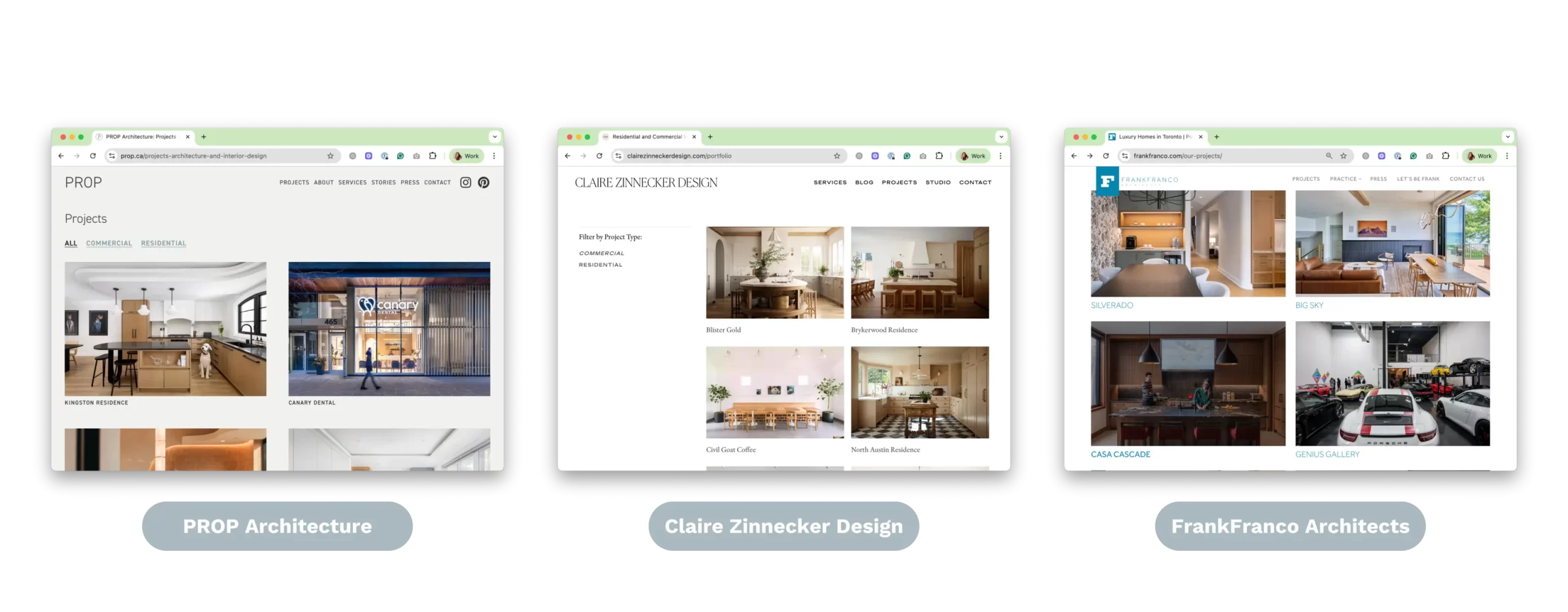
Here’s what that looks like in practice:
- Frank Franco Architects – Architect specializing in modern architecture in Toronto, Ontario. Projects are residential and commercial (restaurants), but always modern, always in Toronto.
- Claire Zinnecker Design – Interior designer in Austin, Texas, specializing in residential and boutique retail. Everything has a signature Texan aesthetic.
- PROP Architecture – Residential (condos/penthouses) and commercial (dental offices in condo buildings) in Toronto, Ontario. All modern and minimalist.
See the pattern?
How You Can Do the Same
All three example firms have residential and commercial projects, but their portfolio is anchored by a specific location and a consistent aesthetic.
In the design and construction industry, you can specialize in three main ways:
- Location
- Aesthetic
- Property type
If you want to do both residential and commercial, you’re taking property type off the table. That means your location and aesthetic must be crystal clear.
Think of it like pulling levers:
- If one lever (property type) is broad, the other two must be specific.
- Avoid the nightmare scenario: residential + commercial, across three cities, with completely different styles. That’s marketing chaos.
Then What?
When your positioning is clear, marketing becomes easier (and cheaper):
- Instagram – Organic content and ads? You know exactly which location to target, which hashtags to use, and which projects to showcase.
- Website and SEO – You know which keywords to use and how to curate your portfolio.
- Networking – Focus on events in your target location.
- Testimonials – They reinforce your expertise in that aesthetic and location.
I’d love to see how you’re doing this.
See you next Thursday,
Daniela