Quick Summary

On the surface, Canada and the U.S. look like identical twins—same language, shared history, and nearly identical cultural scores. Yet, we’ve seen countless firms try to "copy and paste" their strategy across the border only for it to fall flat. This post dives into the 20% nuance that makes or breaks a cross-border expansion. From stricter email laws to the subtle shift from individual success to community-driven messaging, we explore why the smallest cultural gaps require the most intentional marketing adjustments to ensure your brand truly clicks with a new audience.

→ Enjoyed reading this? Join the email newsletter.
I’m Canadian. But every time I visit the USA, I feel a bit of culture shock.
Which is strange. On the surface, Canada and the USA look almost identical. Same language, similar history, culture, even food.
So why does it feel different?
About half of our clients are in the U.S. Sometimes, they hire me to “Canadianize” their marketing when expanding here.
And I hear the same thing over and over:
“We tried to copy and paste our strategy into Canada… and it didn’t quite click. Why?”
Let’s Look at the Research
In the 1960s, social psychologist Geert Hofstede created the Cultural Dimensions Theory to explain how cultures differ.
He said we can understand cultures using six simple “dimensions”:
- Risk Tolerance → Do people take risks or play it safe?
- Power Distance → Do they follow leaders or question them?
- Individualism vs. Collective → Do they focus on themselves or the group?
- Masculinity vs. Femininity → Do they value winning or people more?
- Long-Term vs. Short-Term → Do they plan ahead or focus on now?
- Indulgence vs. Restraint → Do they enjoy life freely or hold back?
Each country gets a score.
When you compare countries like Mexico and Germany, the gaps are big—often 50+ points.
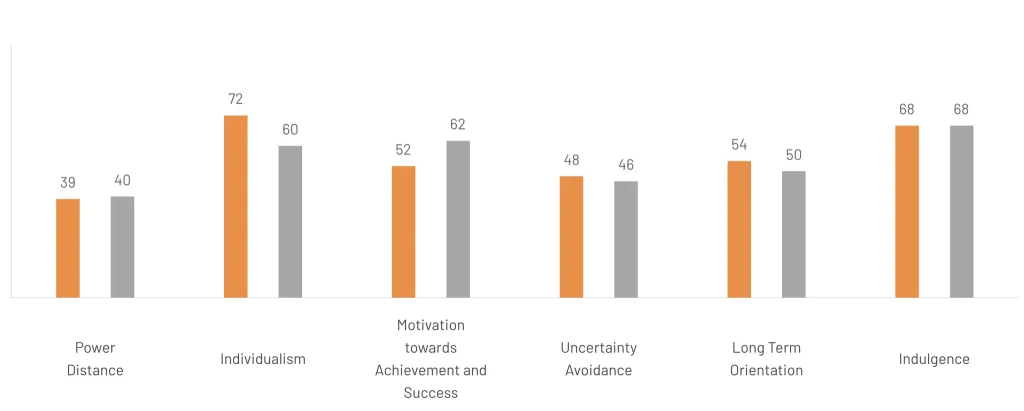
But Canada and the U.S.? Most scores are the same or within 10 points. (See for yourself here.)
In short, we’re almost identical twins.
Lookalike Countries
And it’s not just us. Other countries look just as similar:
- Australia & New Zealand
- UK & Ireland
- Germany & Austria
- Spain & Portugal
- Netherlands & Belgium
- Singapore & Malaysia
They share language, history, and geography. So… can you market to them the same way?
Honestly, almost.
You can reuse about 80% of what works. But the last 20%? That’s where things either click—or fall flat.
The 20% Nuance
Here’s what gets lost in translation between the U.S. and Canada.
- Email marketing. Canada has stricter laws (CASL), requiring clear consent before emailing. The U.S. is more flexible with opt-out rules and state-by-state variation.
- Market Size. The U.S. has 8x the population. It’s easier to niche, but also more competition. In Canada, audiences are smaller, and reputation spreads faster.
- Buying Local. Both countries value local, but but Canadians tend to lean more into “Canadian-owned” and community-driven messaging—especially during political tension.
- Individualism. This is one of the biggest gaps in Hofstede’s research (though still only 12 points). Canada leans more into diversity and inclusion, while U.S. marketing tends to highlight the individual. In Canada, community-driven, “we’re in this together” messaging often performs better.
None of these are extreme differences. But they’re enough to make the same marketing campaign feel slightly off.
Thinking About Expanding?
I’m curious to hear from you.. Have you ever tried marketing across the border? How did it land?
If you’re expanding and want help adapting your strategy, just reply to this email or reach out. I’d be happy to help.
Tchau,
Daniela